I was recently tasked with finding an Airbnb for an upcoming family trip. I’m the type of guy who likes to do a lot of research (hopefully you can tell from the newsletter). So I asked ChatGPT what neighborhoods I should search in and then went straight to the map search on Airbnb. I do the same thing in Resy when struggling to find a place for date night. The location matters, so the list view just isn’t as helpful.
The smart people at Airbnb realized the same thing. Optimizing for search results in a list is easy-peasy. Just put the best stuff on top. But how does that work for a map? There is no top.
Today in another Tiny Big Moves edition, I’m discussing how Airbnb figured out how to optimize map search and what that means for your product.
The Backstory
How Airbnb got here.
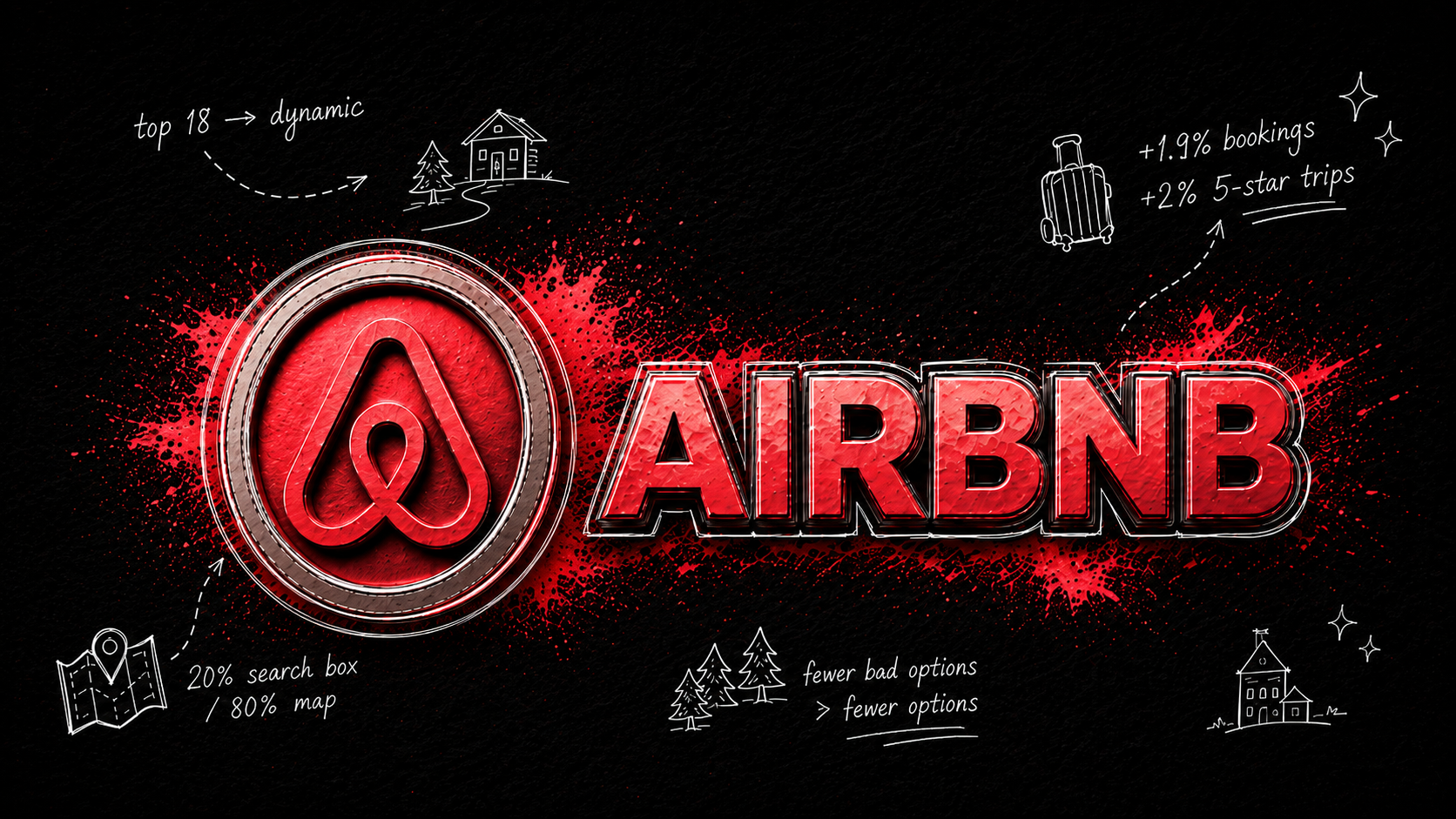
Only 20% of searches come from the search box; the rest come from the map.

Search teams are obsessed with you finding a listing you like. They grade their ranking algorithm with a score that asks, roughly: when people click or book something, was it near the top of the results we showed them? When they compared the list to the map, the map results were always 2% worse, no matter what they tried. That’s gotta be frustrating.
They knew from past experiments that if you shuffled list results randomly, there would be an 8% reduction in bookings. They tried the same thing with map results, and nothing happened, which, I mean, makes sense.
Since 4/5 searches were done through a map, though, they needed a win, so they ran a test.
SPONSORED BY

Stride builds teams for early-stage NYC startups and is run by two former PMs who spent the last decade hiring at companies like Amazon, Microsoft, PwC, and VC-backed startups.
If you're struggling to hire or looking for your next role, reach out to their founders: Zakir Tyebjee and Wes Repass.
The Tiny Big Move
The single decision that changed how users behaved.
For years, the top 18 properties were shown on the map at any time. A phone can’t render 1000 pins on a map (no way my fat thumbs would be able to click on it), so they scored them all and just showed the top 18.
But imagine the algorithm found six excellent homes and twelve mediocre ones. Why show all 18?
So the test made the number of pins shown dynamic.
If all 18 listings were competitive, they could all stay. If quality dropped sharply after the seventh listing, Airbnb stopped there.
The results were insane: "Uncanceled bookings increase by 1.9%, measured as a percentage of overall global bookings at Airbnb, making it one of the largest improvements launched over the last several years." Plus, "5-star trips increase by 2%," and guests saw 16% fewer results before clicking the listing they booked.
It’s the type of win you tell your mom about so she can finally compete with all her friends whose children are doctors.
“Your daughter removed a tumor? Very impressive. My son reduced Airbnb searches needed by 16%. Think about that next time you're planning a long weekend.”
The Psychology
At first glance, this sounds like another example of choice overload: give people fewer options, and they'll have an easier time choosing.
Except Airbnb tested that explanation.
They created another variant that randomly removed the exact same number of pins. Same count, but different selection. Bookings fell 1.5%, proving that fewer options weren’t better, but fewer bad options were better.
Simply reducing options only works if the options are generally interchangeable. When I’m buying taco shells, I just need a few options because they are kinda all the same. The same can’t be said about homes.
But why did the random selection perform so much worse than the quality selection? There's a psychological phenomenon that explains this: the presenter's paradox.
When we're presenting something, we tend to think additively: if one good thing is valuable, surely one good thing plus another decent thing is even better. But the person evaluating the set doesn't necessarily think that way. They often average.
Researchers found that adding a cheap gift card to an expensive sweater could make the overall gift seem less generous. The mediocre addition diluted the great one (Weaver, Garcia & Schwarz, 2012).
So every Airbnb added doesn’t just add more choice; it also changes the perceived quality of the choice set.
SPONSORED BY

You bought something online with a credit card. You may have even used the “right” credit card.
But did you:
Activate offers on your credit cards
Use a shopping portal
Check for heavily discounted gift cards
Shoppers who use Savewise earn 7-10x more points & miles for things they’re already buying.
Savewise finds every way for you to earn rewards and puts them all in one place.
The Takeaway
I think of this as the dilution tax: adding weaker options can make the entire set worse, even when the best options haven’t changed.
Teams tend to think additively. Another search result, recommendation, pricing plan, integration, or feature feels like more value. But users don’t evaluate every option in isolation. They also form an impression of the set.
Imagine Netflix recommends five movies and all five look great. You probably think, Netflix gets me. Maybe it’s actually worth the yearly price increase. Surround those same five with fifteen things you’d never watch, and suddenly the recommendations feel worse.
So when does this apply to your product? Look for three conditions:
Users are choosing from several options at once.
Attention is spread across those options rather than concentrated at the top.
There’s a meaningful quality gap between the best and worst choices.
It could be search results, recommendations, marketplace listings, pricing plans, templates, or even AI outputs.
Having more options isn’t always a bad thing. More options can increase the amount of value in a product while simultaneously making that value harder to perceive.
So instead of asking:
How can we give users more good options?
Ask:
Which weaker options are making our best ones harder to find?
I used to think that more is always better. But the truth is, more mediocre options take away from your product. It’s like a buffet; you always want more food options, even though you know you’ll feel sick afterwards. Let me know what you guys thought of this week’s issue, and as always, share with a friend who might find this interesting!
— Amaraj (aka will never say no to a buffet)
The Meme
