I have an espresso machine at home. I’m one of those guys. I can make you a cortado, cappuccino, or a flat white with a little foam heart (not really; I’m terrible at foam art, so they’re all blobs).
But sometimes, when I need a quick, reliable coffee or it’s PSL season, I head to the nearest Starbucks. I always mobile order through the app so I don’t need to wait in line like some chump.
If I ever do end up ordering at the counter, it’s a nightmare. You’re waiting for so long while the baristas are running around making orders for people who aren’t even at the store yet.
As Starbucks CEO Brian Niccol put it: “The biggest challenge is the fact that the mobile ordering has no sequencing. It’s just first-in, first-out.”
This week on Tiny Big Moves, I’m digging into how Starbucks decided to change the way its queue worked in 2025.
The Backstory
How Starbucks got here.
A typical Starbucks can have up to two queues where orders are received and made. The café, where in-person orders are placed, and the mobile orders share one set of baristas. The drinks are created on an arrival-order basis. The drive-thru has its own barista and its own line.
Starbucks would run into problems because 'there is no gating on mobile orders,' as Niccol described on the Q1 2025 earnings call. "Orders would come flooding in faster than the customer could actually get to the store. So you have drinks that are just sitting on the counter, “at the expense of providing any other experience for a customer that's right in the store”.
It felt unfair to the in-store customers. Why should they wait while orders for absent customers were filled first?
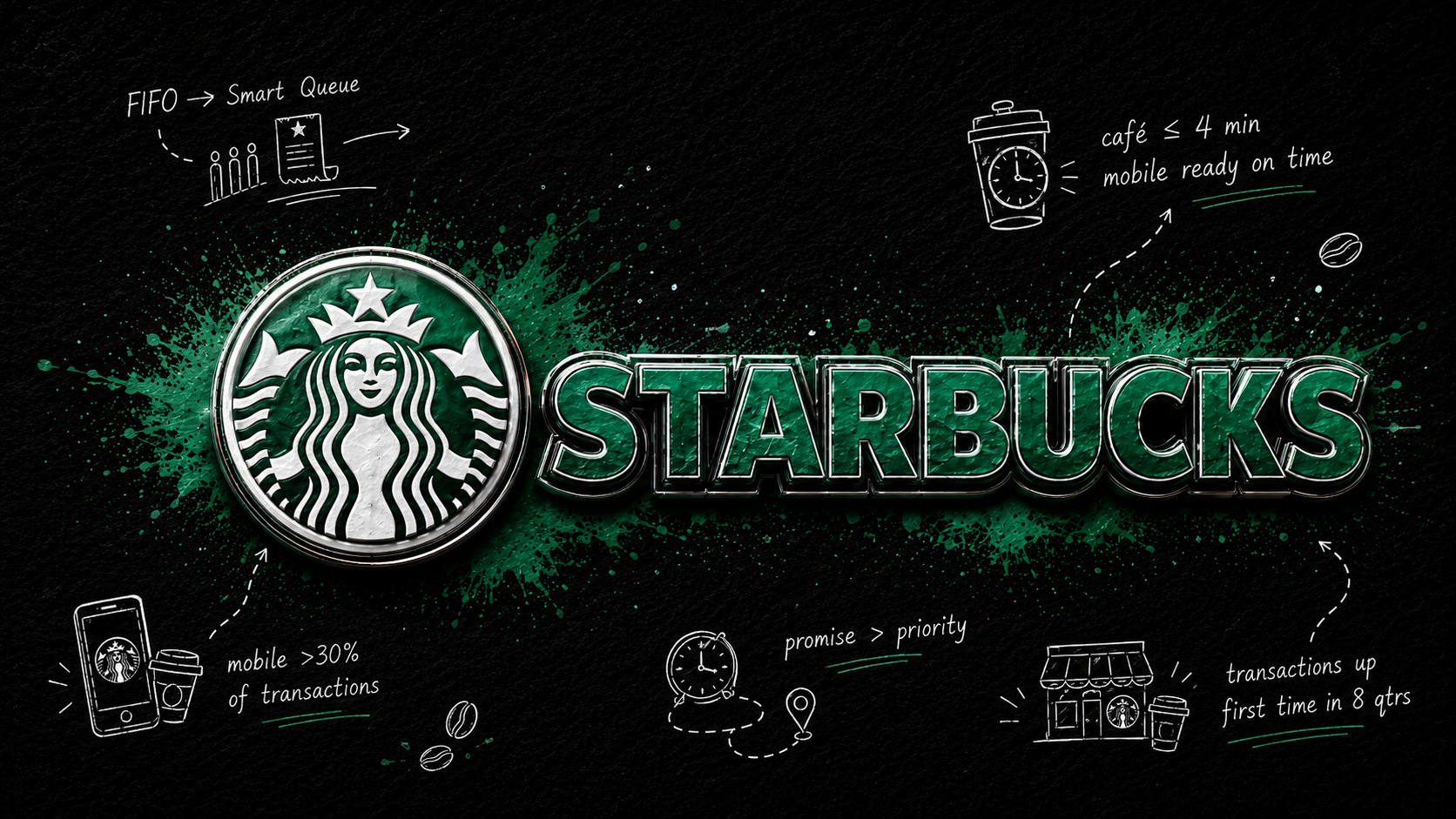
And the situation was only getting worse as mobile ordering had become enormous: by late 2024, it represented more than 30% of transactions.
Neither side was particularly happy with this arrangement.
Starbucks reported a “mid-teens percentage” of Mobile Order & Pay orders going uncompleted during one quarter, citing long wait times of product and availability. Niccol later said customers start bailing once mobile promise times stretch beyond roughly 15 minutes.
Walk-ins were walking right out too (see what I did there) as everyone would show up and “all of a sudden we got a mosh pit”, said founder Howard Schultz. (I now feel confident in saying that Howard Schultz has never actually been in a mosh pit.)
The business suffered as the Q1 FY25 results showed a 4% drop in store sales on an 8% drop in transactions.
SPONSORED BY

Stride builds teams for early-stage NYC startups and is run by two former PMs who spent the last decade hiring at companies like Amazon, Microsoft, PwC, and VC-backed startups.
If you're struggling to hire or looking for your next role, reach out to their founders: Zakir Tyebjee and Wes Repass.
The Tiny Big Move
The single decision that changed how users behaved.
For the tech folks out there, Starbucks basically created an SLA for their customers.
They defined two different service promises:
Café customers: get the drink in four minutes or less.
Mobile customers: get the drink when the app says it will be ready.
They accomplished this through a brand-new algorithm, later branded the Smart Queue. It sequences mobile orders against café demand instead of blindly making drinks in ticket order. Under the old model, arrival time determined priority. Under the new model, the promise helps determine priority.
"It sequences those mobile orders so that it can allow the café order to get fulfilled in a timely fashion and with a touch of humanity", said Niccol.
Starbucks later described its standard as four minutes for café and drive-thru service and better than 12 minutes for mobile promise times. By late 2025, the company said more than 80% of U.S. company-operated stores were averaging café service times of four minutes or less while mobile orders remained highly accurate and on time.
They realized that if they could keep to these promised times and not exceed them, they would “delight the mobile order customer”. The person ordering while on the way doesn’t need their drink made before the person standing at the counter. They need it ready when Starbucks said it would be.
This new algorithm, along with $500 million for additional staffing hours and a reduced menu, resulted in transactions increasing for the first time in eight quarters.
The Psychology
There’s a well-established idea in consumer psychology called expectancy-disconfirmation. We don’t judge an experience purely by what happened. We judge it against what we expected to happen.
Waiting works the same way.
A survey of roughly 1,600 emergency-department patients found that satisfaction was predicted by how long patients waited relative to what they expected. Actual wait time itself wasn’t a significant predictor (Thompson et al., Annals of Emergency Medicine, 1996).
Which is impressive because nobody has ever left an ER thinking, wow, what a delightful wait.
Another study found that giving people information about how long they would wait made longer waits feel more acceptable and improved their emotional response. Importantly, it didn’t work by making the wait seem shorter. Knowing what to expect changed how people experienced it.
So Smart Queue doesn’t need to make every customer’s drink as fast as possible. It works because the café is managed against a four-minute service target, while the mobile customer gets a pickup time they can plan around. It sets expectations well and then fulfills that promise.
SPONSORED BY

You bought something online with a credit card. You may have even used the “right” credit card.
But did you:
Activate offers on your credit cards
Use a shopping portal
Check for heavily discounted gift cards
Shoppers who use Savewise earn 7-10x more points & miles for things they’re already buying.
Savewise finds every way for you to earn rewards and puts them all in one place.
The Takeaway
You can’t eliminate every wait, delay, or unknown in a product, but you can make it predictable.
Look for moments where a user has already committed time, money, data, or attention, but still doesn’t know what happens next or when it will happen. Examples include:
An application is “under review”
An AI agent is “processing”
A support ticket says “we’ll get back to you soon”
In each case, the user has to invent their own expectation. That’s no bueno. So instead, give them a promise.
“Processing” becomes “ready in about three minutes.” “Under review” becomes “we’ll make a decision within two business days.” “We’ll get back to you soon” becomes “expect a response by 2 PM.”
The promise has to be specific enough to be useful and reliable enough to keep. This part is important: once you make the promise, the system behind the product should work toward meeting it, and you should measure how often it does. Treat it like a pinky promise, not like Uber telling me my ride is almost here for 5 minutes straight.
Next time you go to Starbucks, take a stopwatch, and if they take longer than four minutes, insist they throw in a cake pop for free.
Reply to this email with parts of your product experience that you could make more predictable. I’d love to hear about it.
— Amaraj (aka I guess I’ll try the protein cold foam on my cold brew)
The Meme
