I probably make 80% of my non-grocery purchases online. The experience is seamless, and I can do it from the comfort of my couch. Even when I end up returning every pair of pants I purchase because they don’t fit quite right.
Amazon Prime has conditioned me to expect fast, free shipping. There’s nothing worse than finding something you like, going to checkout, and then seeing +$8 shipping. Suddenly the whole purchase feels expensive and silly.
Which is odd, because I probably would have considered the exact same item at $8 more with FREE SHIPPING underneath it. But in my head, it’s easy to justify; either I spend that extra money on the item or on shipping, and who wants to spend money on shipping (the math maths).
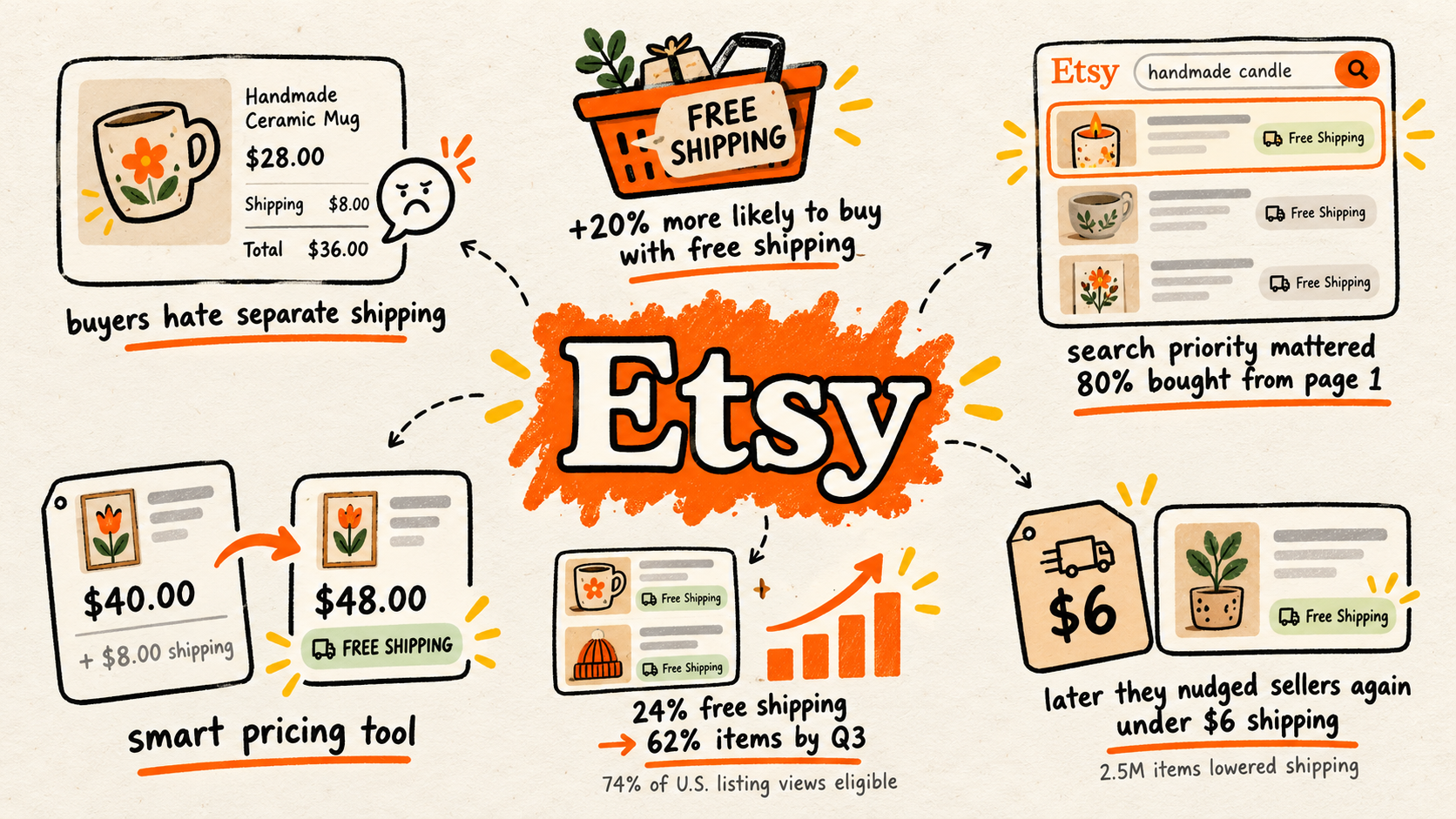
Etsy CEO Josh Silverman came to the same conclusion: “Buyers hate having the cost of shipping broken out separately and rubbed in their faces.”
The Backstory
How Etsy got here.
Etsy, everyone’s favorite place to find unique, personalized gifts, doesn't set prices on its site. Millions of independent sellers set both:
the item price
the shipping price
In 2019, only 24% of items were available to ship for free to the U.S., which was an issue because “when buyers find an item that they like and don't buy, additional cost of shipping is one of the top 3 most commonly cited reasons.” Worse still, in these situations, “buyers tell us they are far less likely to come back to Etsy” (Silverman, Q2'19 call).
Fortune reported that "Etsy's internal research estimates that when a transaction includes free shipping, buyers are 20% more likely to complete the purchase of an item in their online basket" (Fortune, Jul 9 2019).
All signs pointed to offering free shipping, but the problem was convincing sellers.
For roughly two years, Etsy had tried education and encouragement, but it wasn’t enough. And Etsy couldn’t simply tell an independent seller what to charge. But sellers cared deeply about something Etsy did control.
Search.
SPONSORED BY

Stride builds teams for early-stage NYC startups and is run by two former PMs who spent the last decade hiring at companies like Amazon, Microsoft, PwC, and VC-backed startups.
If you're struggling to hire or looking for your next role, reach out to their founders: Zakir Tyebjee and Wes Repass.
The Tiny Big Move
The single decision that changed user behavior.
In July 2019, Etsy announced it would prioritize items in search results that offered free shipping, along with shops that guaranteed free shipping on orders over $35.
And this was a big deal because 80% of items bought through desktop search came from the first page. (It’s like a Google search; if you have to go to the second page, you’ve done something wrong.)
By the end of Q3 2019, "62% of items offered free shipping to U.S. buyers and 74% of U.S. listing views were eligible to ship for free" (Q3'19 results, 8-K).

All the items with the green tag offer FREE shipping. Spooky stuff.
Etsy didn’t expect sellers to absorb the shipping cost. It built a smart pricing tool that let sellers move all or part of the shipping cost into the item price in bulk. In other words:
$40 bedazzled pants + $8 shipping
could become:
$48 bedazzled pants + FREE SHIPPING.
It seems simple, and Etsy’s tests predicted sellers would move about 84% of shipping cost into price. But they moved only 60% of the shipping cost (taking a hit on the remaining 40%). Sellers were lowering the total price more than Etsy wanted, which Etsy estimated created roughly a 1-percentage-point hit to gross merchandise sales. This wasn’t good for Etsy, since it makes money by taking a percentage of sales revenue.
Sellers were “absorbing more of the shipping cost than we think buyers value”, Silverman acknowledged. Aka Etsy didn’t think buyers necessarily needed lower total prices.
Giving free-shipping listings priority meant roughly 40% of listings became ineligible for the first page, even when Etsy’s relevance algorithm would have ranked them there.
While they didn’t disclose the numbers, they acknowledged that this negatively affected conversion rates.
Etsy, however, never walked back the program, and five years later, it doubled down. In 2024, Etsy said expensive shipping was still "a top 10 barrier to purchase."
Etsy said buyers became less likely to purchase once domestic shipping reached $6 or more, so listings under that threshold started receiving priority in search. Shipping didn’t have to be free; it just had to be under $6. After Etsy began surfacing these recommendations to sellers, shipping charges came down on roughly 2.5 million items.
The Psychology
Etsy’s research showed that buyers are significantly more likely to buy an item with free shipping than the same item with shipping fees broken out separately. But why?
In a 1999 study, economists tracked more than 20,000 people shopping for books online, where each book showed item price, shipping, tax, and total in separate columns. They noticed that customers are about twice as sensitive to changes in shipping price and sales tax as to changes in item price.

This is the actual website used in the study. No AI.
This happens because we don’t value every part of a purchase equally. Researchers found that people are more price-sensitive to components that provide relatively little benefit. In a relevant auto-parts experiment, 71% of participants chose an $89.95 part with $32.50 shipping over a $69.95 part with $52.50 shipping, even though the total prices were the same.
People don’t like the feeling of “money being thrown away.”
And there’s another problem. Richard Thaler’s work on mental accounting argues that people judge prices against a reference point, what they expect something like that to cost. Once the rest of the internet made free shipping “table stakes”, any number looks like an awful lot compared to $0.
SPONSORED BY

You bought something online with a credit card. You may have even used the “right” credit card.
But did you:
Activate offers on your credit cards
Use a shopping portal
Check for heavily discounted gift cards
Shoppers who use Savewise earn 7-10x more points & miles for things they’re already buying.
Savewise finds every way for you to earn rewards and puts them all in one place.
The Takeaway
Don’t charge for shipping. That’s it.
I’m kidding, obviously. What’s really important is that when you break down a total price into pieces, you’re asking customers to evaluate each piece separately. That’s fine when each component has obvious independent value.
Pay more for expedited shipping? Sure, you’re buying speed.
Pay more for extra storage? You’re getting more storage.
But mandatory shipping, platform fees, fulfillment charges, setup fees, etc. are perceived as having little benefit to the user. The customer may understand why you incur the cost without feeling like they are getting anything extra for paying it.
The danger zone is a low perceived value + a large, highly visible separate price.
A hotel may have costs associated with its pool, gym, and Wi-Fi. That doesn’t mean guests want to pay a separate $40 “resort fee” for them.
A SaaS company may spend real money onboarding every customer. But if onboarding is required just to use the software, a separate setup fee can feel like paying extra just to become a customer.
An AI product also has real compute costs. But charging separately for every bit of normal AI usage can make the subscription feel incomplete.
In cases like these, the answer isn’t necessarily to eat the cost. Raise the room rate. Bake onboarding into the subscription or annual contract. Include a reasonable amount of AI usage in the plan, then charge separately when someone goes meaningfully beyond it.
A useful pricing question is: Am I charging separately for this because customers value it separately, or simply because it costs me money separately?
Sometimes the better move is to charge where the value is, not where the cost occurs.
I enjoyed researching this issue because I learned something about my irrational purchasing behavior (not that I’m changing it). I really do hate paying for shipping, and I will admit that on occasion, I have spent more money just to hit the Free Shipping limit.
I have quite a few new readers this week; welcome to the Tiny Big Moves community! If you liked this issue, share it with a friend (or an enemy; we don’t mind). For everyone who made it this far, reply to this email and let me know:
What are your irrational purchasing behaviors?
—Amaraj (aka opening my candle Etsy shop next year)
P.S. I’ve added a new Links section below. Check it out!
The Links
What I’m currently reading: Obviously Awesome: How to Nail Product Positioning. Distribution matters so much these days, and positioning plays a big role.
A product I love: brain.fm. I listen to it every day when I’m trying to get deep work done.
A show I’ve been watching: Widow’s Bay on Apple TV. It’s great for the Halloween spooky season. I will admit that I’m a wimp, and it scares me.
A LinkedIn Post you might like: An unfortunately true story of how I spent $170 trying out the new ChatGPT ads.
The Meme

Knowing Drake, his pants are probably closer to $1000.