If you’ve ever been to the US, you know that we have a weird relationship with tipping. It’s a normal part of our culture to tip at a restaurant or when grabbing a coffee. They’ve even made it easier and more expensive to tip with the automated 20%, 25%, 30% (why not just throw in 100% while you’re at it). It’s an awkward experience, always.

Why are the numbers so big?!?
Tipping has also become a norm of the gig economy. If the Doordasher had to trek through the freezing rain to get you the latest trendy froyo, they deserve a tip.
The same goes for ridesharing. As long as your driver doesn’t act like Dominic Toretto (if you don’t get the reference, we can’t be friends), they also deserve a tip. But I do admit that I’ve forgotten to tip on occasion when I’m rushing out of the car. This week we’re talking about a tiny change that Lyft made that solves that exact issue.
The Backstory
How Lyft got here.
Lyft has two main ways that you can tip:
in the app, up to 2 hours after the ride if you haven’t submitted a payment or rating yet.
in the app, up to 30 days later, through the 'Ride History' tab or the emailed receipt.
And Lyft has been working on increasing rider tipping for years. (I’ll leave you to speculate why this is so important to them.)
Back in 2018, the company introduced in-ride tipping after noticing that riders open the app during 53% of trips. They also launched default tipping, which auto-applies a pre-set tip percentage, which could help when a rider was “in a hurry or forgets to tip.” Finally, Lyft redesigned the tipping screen, which increased driver tip earnings by 20%.

This is not my actual hand (for those wondering).
While Lyft did a lot of work to help riders tip, an issue remained. The problem was the gap between wanting to tip and actually doing it when Lyft asked.
Anthony Sledge, a growth marketing manager at Lyft, had a sneaking suspicion that most riders want to tip their drivers, but just forget. In fact, he was one of them. “I tip on everything—food delivery, coffee, everything.” But not rideshare.
So he decided to test whether there were more riders like him.
SPONSORED BY

Stride builds teams for early-stage NYC startups and is run by two former PMs who spent the last decade hiring at companies like Amazon, Microsoft, PwC, and VC-backed startups.
If you're struggling to hire or looking for your next role, reach out to their founders: Zakir Tyebjee and Wes Repass.
The Tiny Big Move
The single decision that changed how users behaved.
Lyft’s hypothesis was simple: some people wanted to tip, but forgot.
So instead of redesigning the post-ride screen again, Lyft kept the original tipping experience and added another chance to act.
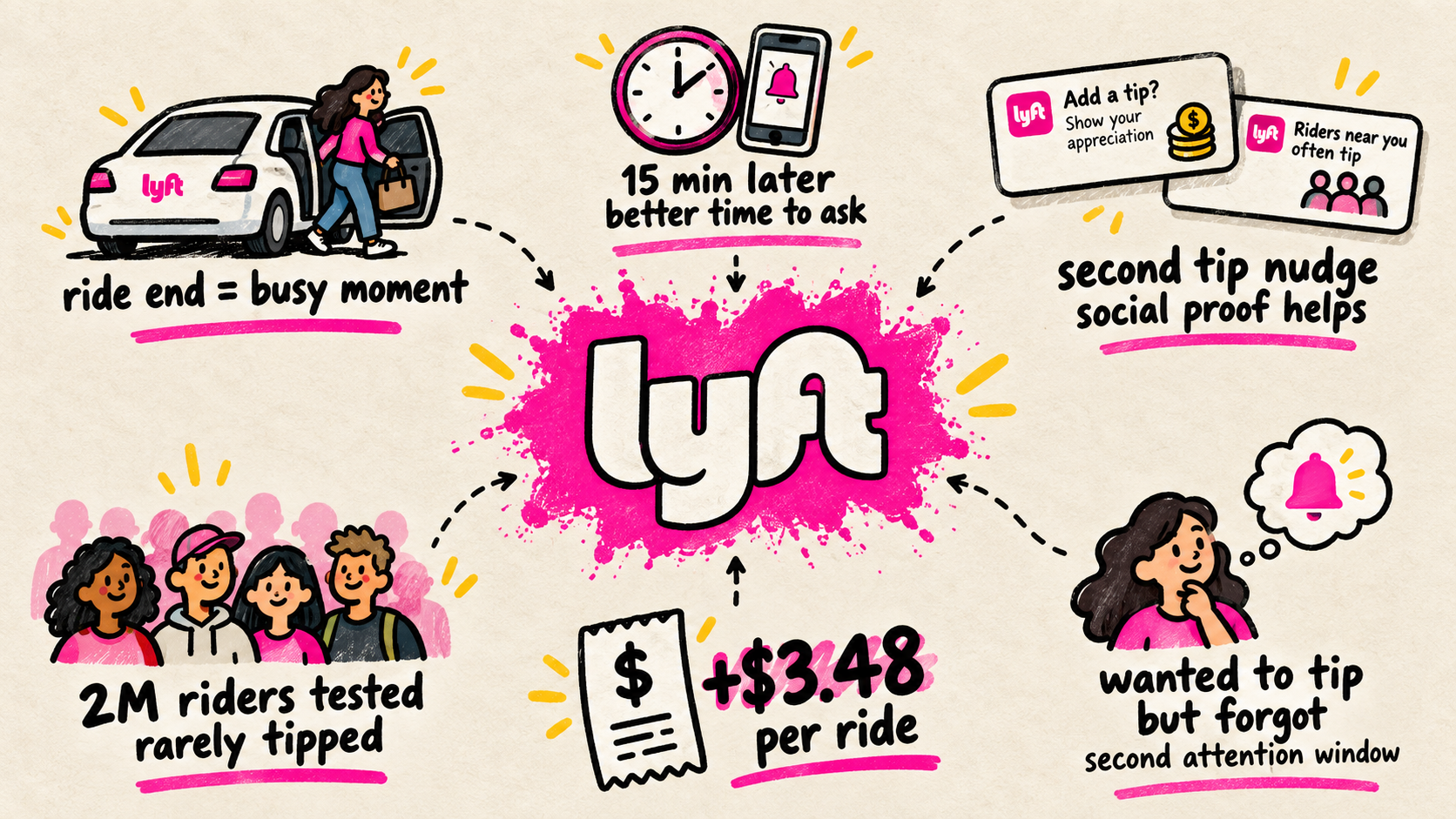
They first tested sending holiday-themed push notifications to two million riders who never or rarely tip their drivers, 15 minutes after their rides ended.
The control group received no push notification, the second received a notification encouraging a tip (below left), and a third got one that included the number of other riders in the area that had tipped last month (below right).
After two weeks, Lyft reported that riders who received the notifications tipped an additional $3.48 per ride compared with riders who got no push. Both variants increased the number of tips and the tip value.
Side note: I’m very bullish on the social proof/social guilt strategy. No one wants to feel cheaper than their peers. I’m pretty sure that one was the ultimate winner.

Since both variants increased the number of tips, we can reliably say that the push notification sent 15 minutes after the ride ended was the key factor in the test. It reminded users to tip by creating a second “attention window” when they were free to take action.
As a growth PM, I’d really love to run a follow-up test. We could send the notification at different time intervals (5, 10, 15, 20 minutes) to see if there is a best time.
The Psychology
Psychologists call remembering to carry out an intended future action prospective memory.
You can genuinely intend to do something and still fail to retrieve that intention when the opportunity arrives. That becomes especially likely when your attention is occupied by something else. It’s like when my wife reminds me to purchase flights for the holidays at dinner, but when I get back home, I’ve completely forgotten. And now the only affordable flights have a 14-hour layover 😳.
Researchers studied this problem in a series of experiments on what they call “reminders through association.” Their starting point was similar: people sometimes fail to follow through on intentions because they forget at the moment when they can act.
In one experiment at a coffee shop in Cambridge, MA, researchers gave 500 customers a coupon attached to a flyer for $1 off a purchase two days later. (That’s not going to make much of a dent in my $10 honey rose cold foam oat milk latte.)
Everyone got the same basic instruction: when you get to the cash register on Thursday, remember to use the coupon. But half of the flyers also showed a stuffed alien and told customers that the alien would be sitting by the register on Thursday to remind them.
Two days later, the researchers put the alien next to both cash registers. Among customers who had been told to associate the alien with the coupon, 24% redeemed it, vs. 17% who didn’t have the alien.
The alien brought an existing intention back to mind at the moment they could act on it.
Lyft’s problem has the same shape. The end of a ride is perfectly timed to the event. But it may be poorly timed to the rider’s attention.
You’re exiting the car. Carrying bags. Finding the building. Panicking as rain pours down on you.
But fifteen minutes later, the ride is still fresh, but some of that transition noise may be gone, and your phone is probably back in your hand.
A reminder is most useful when it brings an intention back to mind at a moment when the person can actually act on it.
SPONSORED BY

You bought something online with a credit card. You may have even used the “right” credit card.
But did you:
Activate offers on your credit cards
Use a shopping portal
Check for heavily discounted gift cards
Shoppers who use Savewise earn 7-10x more points & miles for things they’re already buying.
Savewise finds every way for you to earn rewards and puts them all in one place.
The Takeaway
When you’re building a product, you typically tailor certain user actions to the relevant event.
Workout ends → ask the user to rate it.
Purchase completes → ask the customer to join the loyalty program.
Those aren’t necessarily bad moments to ask. They’re just the obvious ones. The mistake is assuming that because an action becomes relevant at that moment, it must also be the moment when users are most receptive to doing it.
It’s worth asking: "Do users have enough attention to act when I'm asking?"
That creates an opportunity for a second attention window.
Look for actions where:
the first ask happens during a busy or transitional moment,
the action is optional rather than required to complete the core task,
the action still has value minutes, hours, or even days later,
and you have some reason to believe at least some users may still want to do it.
Taking our previous examples:
The fitness app might ask someone to record workout notes immediately after they finish. But they may still be catching their breath or re-racking weights. Instead, the app could ask twenty minutes later, when they’re free.
The e-commerce flow might ask a customer to join its loyalty program immediately after checkout. But at that moment, the customer mostly wants confirmation that the order went through. A better time might be after the order is delivered.
So before making the original ask bigger, louder, or more persuasive, test a second ask that might not compete for their attention.
We have a bunch of new subscribers this week, so thank you all for joining! I hope you all enjoyed the article. Next time you take a rideshare, check to see when you’re asked to tip and share it with me!
Quite a few people answered my riddle last week, so I thought it would be fun to do it again; reply with your answers to the riddle below:
What can you keep after giving it to someone?
—Amaraj (aka my Lyft/Uber rating is higher than yours)
The Meme

Real footage of me in the backseat of the car