Growing up in California, I’ve always associated Arnold Schwarzenegger not with a bodybuilding legend or the Terminator, but as the Governator.

I can’t believe we voted in a man who was sent to kill us by AI.
Only later in life did I watch Pumping Iron, the 1977 movie that turned him into a household name. If one thing will motivate you to work out, it’s seeing Arnold do bicep curls in the gym. That’s why I’m not surprised he created his own workout app, Pump Club (great name, btw).
What I am surprised about is the clever mechanism he uses to get people to actually stick with their workout programs, and how it can help you improve retention in your own products.
The Backstory
How Pump Club got here.
You can’t teach an old dog new tricks (trust me, I’ve tried), and most people fail their New Year's resolutions by February 1st for a reason. It’s hard to build habits. Any app that requires you to build a habit before you understand its value knows how hard it is.
The median Fitness app only retains 24.4% of annual subscriptions after one year, below the 27.5% all-app median. People sign up for a year-long fitness app membership, only to forget about it and cancel before building the habit. The same thing goes for meditation, language learning, saving money, flossing, etc.

Entertainment & Travel retain the best. Fitness & Education struggle.
We want to be better versions of ourselves, but behavior change takes real effort, and we're unfortunately lazy.
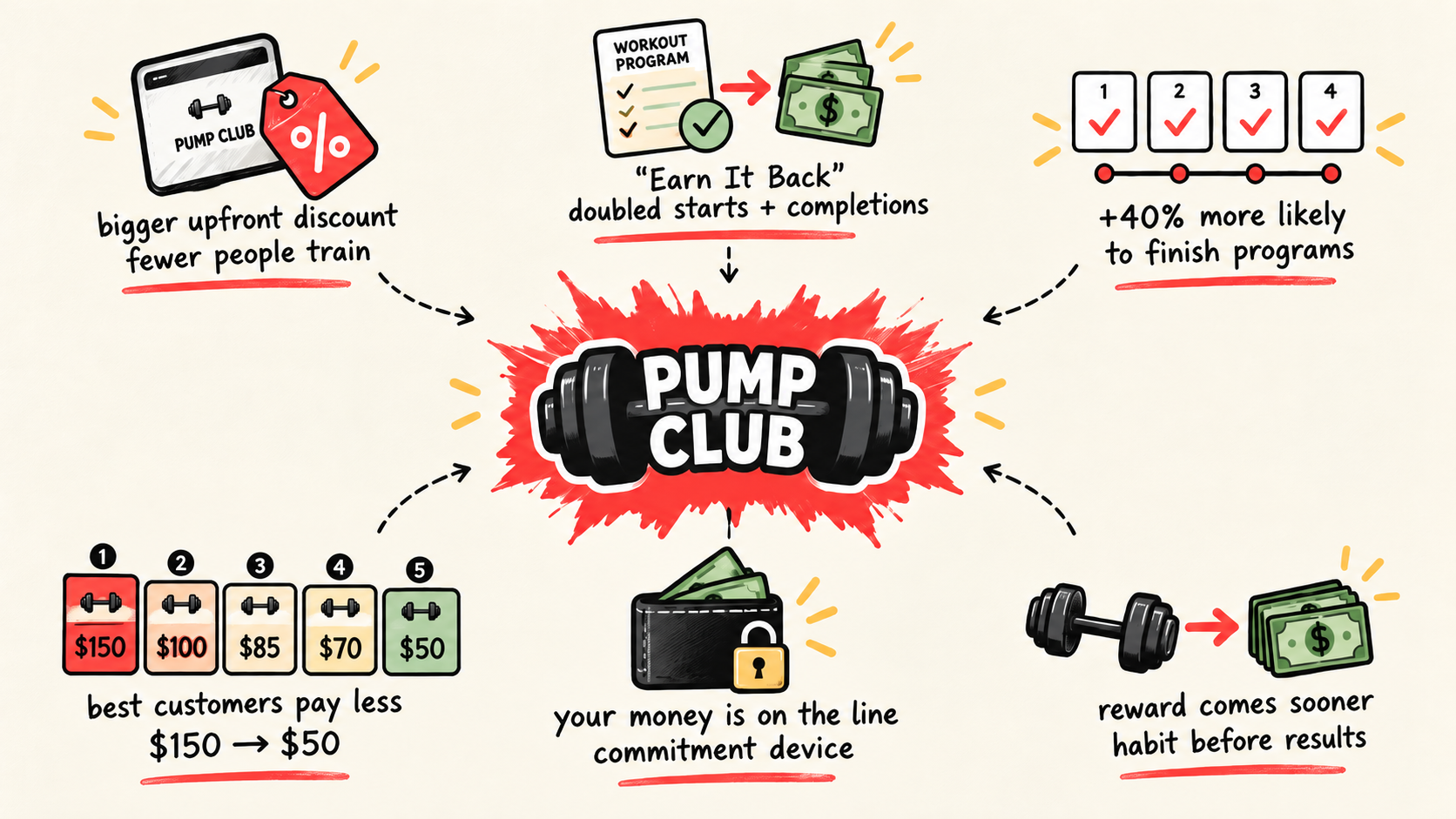
Arnold (we’re on a first-name basis) realized through years of experimenting with Pump Club that the more discounts they offered, the more people joined, BUT fewer people showed up and fewer finished programs. The bigger the upfront discount, the less people train.
And if people don’t actually use your app, they won’t realize the value of it, and they won’t renew. So habit-building directly ties to lifetime value (LTV).
SPONSORED BY

Stride builds teams for early-stage NYC startups and is run by two former PMs who spent the last decade hiring at companies like Amazon, Microsoft, PwC, and VC-backed startups.
If you're struggling to hire or looking for your next role, reach out to their founders: Zakir Tyebjee and Wes Repass.
The Tiny Big Move
The single decision that changed how users behaved.
Sure, you can build habits with gamification features like Streaks and Prizes, but do you know what’s more compelling than that? Money. Cold, hard cash.
Instead of lowering the price to convince people to join, Pump Club pays members back for finishing a workout program through a program called Earn It Back. The program doubled both start and completion rates.
The app also claims that members are 40% more likely to complete their programs with Earn It Back.
This is how it works:

Its best customers pay the least. A member who does nothing pays $150. A member who finishes all four programs pays $50. You earn a discount by following through and building a habit.
The LTV Play
It seems a little weird because Pump Club’s most successful customers become its lowest-revenue customers in year one. But it actually makes sense because they are optimizing for LTV. If they can incentivize users to work out and renew year after year, that retained user's total revenue will be higher than that of a customer who churns after year one.
I personally like this incentive structure more than a gamification lever, even though it costs more, because it is more universally compelling. It feels like you’re winning money for completing something you already set out to complete.
The Psychology
There’s a well-studied idea behind part of this called a commitment device. You put something valuable at risk today to make your future self more likely to do what you say you want to do.
A 2015 study tested financial incentives for smoking cessation among CVS employees. One group could earn a reward for quitting. Another had to put down a refundable $150 deposit, which they would get back plus a reward if they quit successfully. But almost nobody wanted it. About 90% of people accepted the reward program, but only 13.7% accepted the deposit program.
Pump Club’s Commitment Device
Pump Club sidesteps that participation problem because users never have to explicitly opt into a separate commitment device. Part of the money they already paid for the product simply starts behaving like a commitment device. It’s easier to accept because the commitment is bundled into the purchase.
Loss Aversion
Another psychological force may be helping Pump Club: loss aversion, our tendency to feel losses more strongly than equivalent gains.
In one study, employees with a daily step goal were either paid $1.40 for each day they succeeded or given $42 at the beginning of the month and lost $1.40 for each day they missed. As you may have guessed, the loss-framed group hit their goals 45% of the time, vs. 35% for the other group.
The phrase “Earn It Back” does a lot of the heavy lifting here.
Instead of:
Finish the program → earn $50
It encourages you to think:
There’s $50 of my money sitting there → I lose the chance to get it back if I quit.

Pulling Forward The Reward
One last explanation is at play here. The reward from exercising regularly takes a while to become noticeable. You work out today so that weeks or months from now you might be stronger, healthier, or look different.
Pump Club inserts a much nearer reward into that gap. You finish the first program, and you get a reward, $50, before you might see any physical results. It turns delayed gratification into something that feels more like instant gratification.
SPONSORED BY

You bought something online with a credit card. You may have even used the “right” credit card.
But did you:
Activate offers on your credit cards
Use a shopping portal
Check for heavily discounted gift cards
Shoppers who use Savewise earn 7-10x more points & miles for things they’re already buying.
Savewise finds every way for you to earn rewards and puts them all in one place.
The Takeaway
Products have different activation efforts. You only need to send one message to ChatGPT to see how powerful it can be. You only need to win one bet (and lose ten) to get hooked on sports gambling.
But products that require repeated use and behavior change require much more activation effort. A language app only works after enough practice that you notice yourself improving. A meditation app seems only worth it after you can comfortably meditate for minutes on end.

For these products, activation is a habit, not just an event. And that creates a dangerous gap between paying for the product and experiencing why it’s worth paying for.
Pump Club aligns incentives with activation effort. It motivates users to move from wanting the outcome to sticking with the behavior long enough to experience it.
When It’s Relevant
Ask: “What does a customer need to accomplish before they truly understand the value of our product?”
It should be a meaningful success milestone, not an arbitrary engagement metric. A fitness app probably shouldn’t pay someone for opening the app seven days in a row. It might reward completing an actual training program. A savings product might care more about several months of consistent deposits than about checking an account every day.
Then work backward from the economics. If reaching that milestone makes customers substantially more likely to retain, the company can afford to spend some of that future value helping more users get there. Pump Club chose cash back, but the incentive could be credit, a lower renewal price, unlocked features, waived fees, or something else customers genuinely value.

Someone build this. I keep giving up on meditation.
The Three-Step Playbook
Identify the first meaningful success milestone. Use cohort data where possible to find the behavior or outcome most associated with later retention.
Estimate what reaching it is worth. Compare the retention, LTV, or contribution profit of customers who reach the milestone with those who don’t. That gives you an upper bound on what it might be rational to spend.
Choose a meaningful incentive. It should be large enough for users to care about without wiping out the additional value you hope to create.
A language app could return part of an annual plan as someone completes a proficiency exam. A meditation app could give a user a free month of subscription if they complete 30 meditations in a row. A savings app could rebate fees after someone sustains a savings habit for six months.
If you’re struggling to get people to realize the value of your app, you might want to financially incentivize your users.
Cash rules everything around me, CREAM; get the money, dollar, dollar, bill, y’all.

I’ve been waiting many months to be able to drop a Wu-Tang reference.
I hope more products try using this incentive structure; it would definitely work on me. It would also get me to pay for more apps. One thing I’ve been pushing on lately: making these articles more directly implementable. If this one gave you something you could actually try, let me know.
A riddle, since a few of you asked. Reply with your answer:
What can you serve but never eat?
— Amaraj (aka maybe I’ll finally achieve my New Year's fitness goals)
The Links
A newsletter I recommend: Numlock News. It’s a daily quick-read newsletter about random news stories grounded in stats.
A product you should try: Claude Design. You can do so much with it. Try recreating your resume in it and let me know how it goes.
A trick to never lose your phone again: Post here. I’m definitely going to implement this in our home.
A Reddit thread to find your next watch: Thread here. I’ve actually used recommendations from this thread, and they’ve been great.
The Meme

I’m constantly living on the spectrum of Thors.