Hi friends! As some of you know, I’m trying to grow the newsletter, and I could use your help. If you enjoy being a Tiny Big Mover, please do me a favor and share this newsletter with someone. Now, let’s get into it.
Everybody has a favorite starter word for Wordle. Mine is “RAISE.” My editor apparently just goes with whatever she is feeling for that day. Risky.

I started off struggling, but what a great save for the team.
I don’t read the news every day, but I always check the daily mini crossword or Connections on my (normally delayed) morning subway ride. Which got me thinking about how The New York Times decided to buy Wordle, and what that can teach us about getting users to return to our products.
The Backstory
How NYT got here.
Think about where you get your news from. Is it still from your local news station at 6 AM? Or from the newspaper that was thrown into your driveway (with incredibly good aim)?
I now get my news from podcasts, LinkedIn, Instagram, TikTok, and yes, sometimes the NYT.

My local news reporter (hopefully someone gets this).
This year the Reuters Institute found that social media and video networks had overtaken both television and publishers’ own websites and apps as sources of news. And 10% of people already use AI chatbots for news, up from 7% last year.

NYT CEO Meredith Kopit Levien said The Times isn’t just competing with other newspapers. It’s competing for attention with some of the most powerful information companies in the world, aka Meta, Google, etc.
Her conclusion:
“We’ve got to get really good at making people want to come back... people have to ask for us by name.”
That is a very different problem from simply producing good journalism. People have limited time and bandwidth, and all these apps are competing for it. Their competition isn’t just other news sites; it’s also Netflix, YouTube, GTA6 (who else here has already pre-ordered?).
SPONSORED BY

Stride builds teams for early-stage NYC startups and is run by two former PMs who spent the last decade hiring at companies like Amazon, Microsoft, PwC, and VC-backed startups.
If you're struggling to hire or looking for your next role, reach out to their founders: Zakir Tyebjee and Wes Repass.
The Tiny Big Move
The single decision that changed user behavior.
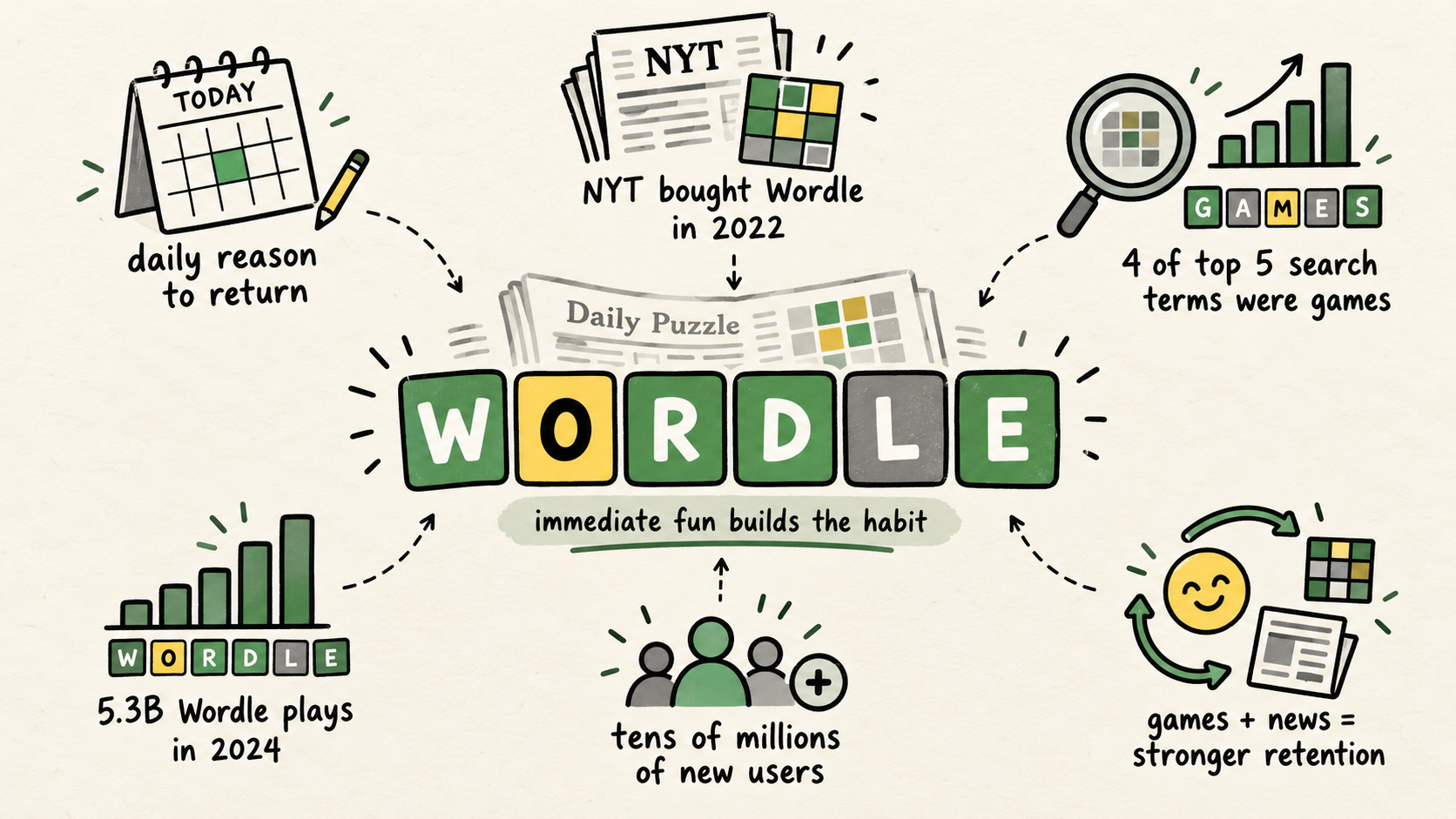
On January 31, 2022, NYT bought Wordle, a little word game with millions of daily players. They kept it free, and it’s still free today. (Pssst, there is a hidden Wordle-esque puzzle on my site; try to find it.)
The CEO’s reasoning on the earnings call: “It gives them reasons to come to The New York Times every day.” Games act as a daily anchor to the publication in a way that news isn’t really these days.
Wordle is the best type of game for this purpose because it’s a daily puzzle. Every day there is a new word and a new opportunity to win. The same goes for the other games on their platform. They create one small appointment every day with NYT.
Wordle also brought in people who wouldn’t have otherwise come to The New York Times. NYT wanted more non-news readers to come to their site and ideally convert a portion of them to subscribers. They were pursuing a bet on a “broader portfolio of products to meet more needs for more people.”
NYT says its puzzles were played 11.1 billion times in 2024. Wordle alone accounted for 5.3 billion of those plays.
On top of that, if you look at web traffic to their site last month, four of the top five organic search terms to nytimes.com were game-related:

So clearly purchasing Wordle and doubling down on adding games has had its intended effect.
Attention → Money
Eyeballs alone don’t matter if they don’t convert. NYT credits Wordle with bringing “tens of millions” of new users to the Times and helping drive its best-ever quarter for Games subscriber additions. There’s even a Games-only subscription for people who hate reading.

Who wants to split a Family membership with me?
And Jonathan Knight, who runs NYT Games, has said subscribers who engage with both news and games in a given week are much more likely to retain over the long term.
Even if users don’t convert, NYT still makes a boatload of money off ads that show before the games.
A similar story for LinkedIn
LinkedIn launched its own daily games in May 2024 to solve the same problem.

I mean, I honestly might start playing these games; they look fun.
LinkedIn is a when-you-need-it product. You update your profile when you’re job hunting. You check a message when somebody sends one. You post when something happens in your professional life (or every day if you’re like me 😬).
Games provide the same solution here and give users a reason to come back every day. But more importantly, for LinkedIn, the games give a reason for people to connect. In 2026, the executive leading LinkedIn Games said games had become one of the platform’s largest drivers of conversations. Side note (because I’m a cynic): I’m not really sure how these games are drivers of conversation…” Hey Bob, saw you got a high score in Zip; we should catch up!”

Quick, gotta update my resume that I’m smarter than 31% of newbies
It says 86% of players return the next day, and 82% are still playing a week later, but those are retention rates among people who already chose to play.
The Psychology
News and professional networking have something in common. Much of their value arrives later. You read the news today so you become more informed over time. You build a professional network because it might produce an opportunity someday. A game provides immediate gratification.
Researchers found across five studies that immediate rewards like enjoyment predicted whether people persisted toward their goals like New Year's resolutions, while delayed rewards did not.
The Daily Drop
Wordle gives you a reason to come back the next day. It’s always new and shiny. There’s also only so much Wordle you can play today.

Research shows people tend to consume things they enjoy too rapidly, growing tired of initially well-liked stimuli such as a favorite snack or an enjoyable video game more quickly than they would if they slowed consumption. It’s like how I feel sick every time I eat a dessert (tiramisu pls) because I inhale it.
Wordle effectively forces the break for you and keeps you coming back.
SPONSORED BY

You bought something online with a credit card. You may have even used the “right” credit card.
But did you:
Activate offers on your credit cards
Use a shopping portal
Check for heavily discounted gift cards
Shoppers who use Savewise earn 7-10x more points & miles for things they’re already buying.
Savewise finds every way for you to earn rewards and puts them all in one place.
The Takeaway
Some products are naturally habitual. You open weather because tomorrow’s forecast changed. You open a fitness app when it’s time to work out. You open Slack every hour because your boss won’t stop messaging you.
Other products have plenty of value but no natural reason to return very often. You visit a travel site when you’re planning a trip. You go to FB Marketplace when you need to buy or sell something.
For products like these, a growth opportunity might be creating a reason to come back between the moments when the core product is needed.
It could be:
a daily or weekly personalized insight,
a challenge or prompt,
a market or industry briefing,
a poll or prediction,
or, yes, a puzzle.
It needs to deliver some value on its own and occur on a regular cadence.
This works best when more frequent contact actually helps the product: more visits to monetize, cross-sell, strengthen the brand, or compound engagement.
And I do think it helps if the product you create is fun.
A few examples:
A marketplace might do: weekly personalized trend → visit → browse listings
A learning product might do: daily challenge → visit → continue the course
A travel product might do: weekly lottery → visit → book hotels

So the question I’d take back to your team is: What is the natural reason people return to our product today?
And if the answer is: “There really isn’t one until they need us again,”
then ask: Could we create a small recurring experience that is worth returning for on its own, and place it next to the part of the product we ultimately want them to use?
I’m a fan of making software more fun. Sometimes products add games just to delight users, and sometimes they serve a purpose. And now that AI means the effective cost of shipping new features is zero, I hope to see a lot more games in the future. (If anyone from TurboTax is reading this, please make the tax process more enjoyable.)
—Amaraj (aka my favorite NYT game is Connections, fight me)
The Meme
