This week we have a real treat of an article. This is the first in my founder series (pls reply with a better name for this) where I interview a successful founder and uncover a Tiny Big Move they made in their business. As usual, we’ll dive into why it works and what you can take away from it.
It’s fitting that the first founder was also the first sponsor of this newsletter. If you’ve ever tried to rack up a lot of credit card points for an upcoming vacation or wanted to maximize cashback for the $6000 zero-gravity 4D massage chair you’ve had your eye on, you’ve likely heard of Savewise.
The Backstory
How Savewise got here.
Savewise helps people stack shopping rewards. Let’s say Rakuten is offering 10% cash back at Nike and your Amex card has an offer for $20 back when you spend $100. You can potentially use both on the same purchase. Savewise finds those combinations and normalizes rewards like points, miles, and cash back so you can compare them in one place.
Avneesh launched it in April 2024. At launch, it compared shopping portals only, which a legacy competitor, Cashback Monitor, already did for free. As Avneesh put it, “my solution was 20-30% better, but not to the point where people would switch over to it.”
He started with Product Hunt and product directories to get users, but the traffic had high bounce rates and didn’t reach the US shoppers that Savewise was built for.

Savewise on Product Hunt
He then looked at coupon-focused audiences before shifting toward the points-and-miles community, which he knew better and whose members were already trying to earn more points without spending more. To find those users, he used the Map of Reddit tool to identify subreddits they’d be in, starting with r/churning and looking at related communities such as r/amex and r/awardtravel.

The Map of Reddit tool showing results for r/churning
He then cleverly ran the same keywords through Facebook's group search to see what groups existed for this community. And he stumbled upon one where “30,000 people were manually taking screenshots of Rakuten and Amex offers and posting them in a group.” He saw this and realized, “holy shit, this is just a SQL query for me." Aka Savewise had the data from the shopping portals to find these stacked offers at scale.

The famous Facebook Group
And he had already been stacking offers manually by hand. It was part of the reason he built Savewise. The group was proof, in his words, that he was “not the only weird one doing this.” But the issue was that, like many communities, this group didn’t allow for self-promotion.
SPONSORED BY

Stride builds teams for early-stage NYC startups and is run by two former PMs who spent the last decade hiring at companies like Amazon, Microsoft, PwC, and VC-backed startups.
If you're struggling to hire or looking for your next role, reach out to their founders: Zakir Tyebjee and Wes Repass.
The Tiny Big Move
The single decision that changed user behavior.
Avneesh already wanted to add a feature to Savewise that showed stackable offers. But building the real thing meant collecting and reverse engineering offers from the major banks. And he wasn’t sure that people actually wanted this.
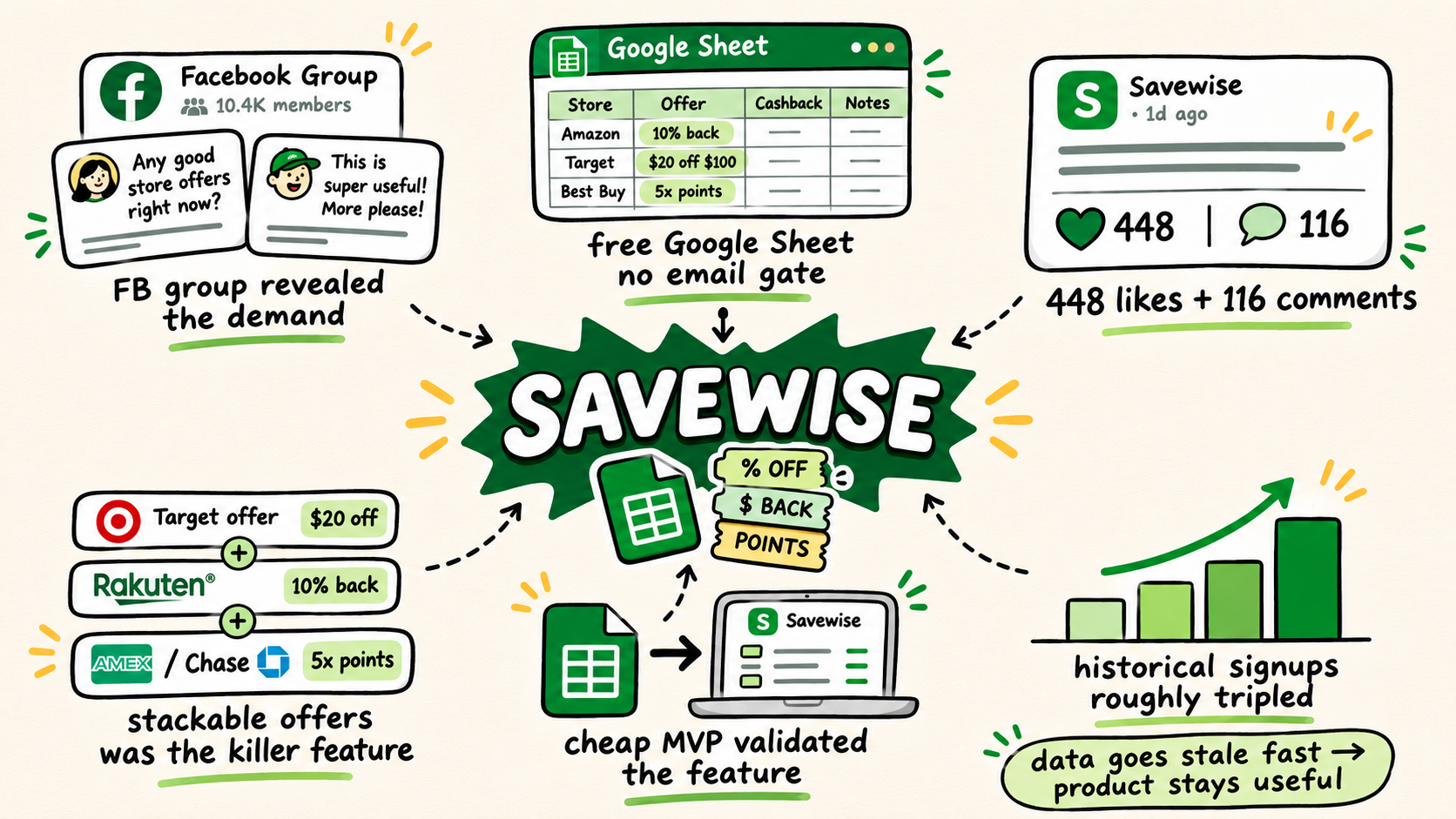
So he ran the SQL query and dumped it into a Google Sheet. It took him a couple of days to organize the data, but when he was done, the sheet showed stores where people could find both a Rakuten offer and an associated Amex or Chase offer.
He posted a screenshot of the sheet with a link to the full list in the group. All for free. No gated download. No email sign-up. Just pure, unadulterated value. The post was a hit and got 448 likes and 116 comments.

No Savewise in the screenshot. SMART.
Importantly, the spreadsheet had a link to Savewise in an “ad slot” at the top. Remember, at this time, he didn’t even have the feature yet, but the content was so useful to his target customer that people wanted to sign up and see what else Savewise could offer them. And Avneesh says that within a couple of days, Savewise roughly tripled its historical signup count.

Free product placement for Savewise at the top of the spreadsheet
This worked so well for a few reasons:
Google Sheets is a frictionless, known experience. You don’t even need an account to view it, and everyone is familiar with a spreadsheet. This lowers the barrier to entry.
The data has a short lifespan. Offer data is continually changing, and the snapshot is going to be relevant for a few days. If people want the most recent data, they need to sign up for Savewise.
No email sign-up. If you’re offering a PDF on how to make a million dollars in a month (I’d like a copy as well), you’ll want to gate it because once people have that information, they don’t need you. But as we said, the data goes stale quickly, so you don’t need to gate the offer.
The spreadsheet was also an MVP
Any good product manager worth their salt (fascinating explanation of the origin of that phrase) tests an expensive feature with a cheap MVP first. And the spreadsheet was the perfect cheap version of a product feature he then built for stackable offers.
People clearly cared about the data in the spreadsheet. He launched it and later edited the Facebook post to tell people that the stackable-offers list now existed inside Savewise and refreshed automatically.
The real version required substantially more work. As Avneesh told me, “I didn’t want to go and do that until I knew there was something there.”
The spreadsheet had done three jobs at once:
It acquired users.
It validated the feature.
And it showed Avneesh exactly which audience wanted it.
Soon after, users told him that "if you give us more data, we'll pay." He then launched Pro and later added a lifetime plan when people asked.
The Psychology
As I said earlier, people trust a Google Sheet. That matters in a community where everyone has their guard up for self-promotion. Honestly, even a link to a sheet is seen with mistrust, but that’s where the screenshot helped to convince people of the value.
Researchers ran a study where a salesperson flattered a shopper either before the purchase, when the selling motive is obvious, or after it, when it's less obvious. When the motive was obvious, both the shopper and people watching rated him less sincere. When it was less obvious, the shopper rated him more sincere.
If Avneesh had just posted a link to his site telling people that the data they wanted was on Savewise, even if it was free, it would have been perceived as insincere. Because the motive is obvious. It’s the same reason that people hate going to a car dealership; they hate getting sold to.

Separate research on consumer sampling found that free samples can create measurable increases in future sales, partly by getting people to purchase products that they wouldn’t have considered buying the brand without a free sample. And unlike other promotions like coupons and discounts, free samples can produce measurable long-term effects on sales that can be observed as much as 12 months after the promotion.
It makes sense why Costco (aka the best place on Earth) has samples in every aisle. One lap of Costco samples plus the $1.50 hot dog and your meals are covered for the day.
Avneesh gave the Facebook group members a free sample of this product. The product’s job was to find stackable offers, and the free sample was a time-bound data dump of those offers. Just like that cookie you sampled, you need more, so you buy the giant tub with 100 cookies (good luck justifying that to your spouse).
SPONSORED BY THE STAR OF OUR STORY!!!!

You bought something online with a credit card. You may have even used the “right” credit card.
But did you:
Activate offers on your credit cards
Use a shopping portal
Check for heavily discounted gift cards
Shoppers who use Savewise earn 7-10x more points & miles for things they’re already buying.
Savewise finds every way for you to earn rewards and puts them all in one place.
The Takeaway
A classic lead magnet withholds value: Give me your email → I’ll give you the answer.
Avneesh did the opposite: Here’s the answer → if you want the continuously updated version, there’s a product for that.
That works especially well for a data product that produces information that changes over time.
Prices.
Deals.
Rates.
Availability.
Rankings.
Jobs.
Inventory.
Benchmarks.
New leads.
It can simply be one useful output from the product.
A flight-price tracker could post the cheapest international fares leaving Chicago this week in a Chicago travel group. A rent-data product could post which Brooklyn neighborhoods saw the biggest rent changes this month. A recruiting-data product could share this week’s newly funded startups currently hiring engineers. A sales-intelligence product could post the 20 companies in an industry that hired their first VP of Sales this month.
The pattern is the same: Give people today’s useful answer. If the answer naturally changes, the product becomes the easiest way to get tomorrow’s.
It’s hard to overstate how impactful this really is. Right before I interviewed Avneesh, he had posted on a Capital One subreddit about high-value offers that had dropped. As we were chatting, every five minutes he would show me the 10 or so new users that had just signed up from that post.

Even if you don’t consider yourself a data company, ask your friendly AI agent if your product generates any interesting data as a byproduct that a subset of people might find useful. Then find the communities that would want it and offer them a free snapshot.
Alternatively, find communities and groups where your users hang out and see what types of data are posted. Then see if you can generate that data and create a new feature around it.
I’d love to hear what you thought of this new series. If you know any founders who would like to be featured in an upcoming newsletter edition, send them my way!
And if you’re looking to maximize your credit card offers and get cashback for your upcoming holiday shopping, create a free account on Savewise. And someone buy me something off this gift guide.
— Amaraj (aka catch me in the Sheets with my data)
Tiny Big Questions
What’s one thing you run with AI today that you’d have hired someone for a year ago?
“Basically everything.” Avneesh runs his whole product process through Claude Design. He brain-dumps the feature, and it writes a lightweight spec. It pulls in related customer support requests and helps him decide what’s MVP. Then it designs every screen for web and iOS from his design system. With PostHog connected, it can also check what the funnel looks like before it reprioritizes anything. His marketing person designs emails the same way, and Loops builds them.
What’s the first metric you check in the morning?
“Daily signups.” Yesterday’s, specifically.
One book you’d recommend?
“Company of One.” Which makes sense as a solo founder running a company with no full-time employees.
What’s something most founders believe that you think is wrong?
That growth comes first. “For the last two and a half years, I was happy if we got 10 signups a day. I just cared about getting the right people, and that the product was good and that they were sticking around.” If Savewise only ever serves the points-and-miles crowd, he’s fine with that. “Not all products are meant to do everything.”
Favorite restaurant in New York right now?
“Tacos del Barrio in Prospect Heights.” Oddly enough, he goes for the burrito.
The Meme

Me this past summer explaining how I paid for my honeymoon