I love sharing a referral code with a friend. One, because it means I recommended something that I know you’ll like, and two, because I usually get a reward with it. (If there’s a product you’ve been eyeing, ask me and I bet I have a referral code.)
As a growth person, when implementing referrals, you usually identify and prompt your happiest users and then offer them an incentive to refer. Either a discount on an upcoming payment, or status, or merch, or something enticing.
Referred customers are the best because they already trust you. You were recommended to them by someone they trust. Trust is a transitive property (like my wife’s taste in TV shows, which has now somehow become my taste too).
Today we’re discussing how Monarch Money discovered an unexpected opportunity to prompt their users for referrals and the massive success they had with it.
The Backstory
How Monarch got here.
Monarch Money is a paid personal finance app that pulls your bank accounts, credit cards, investments, and other financial accounts into one place. They’re a replacement for the spreadsheet that you once created on New Year’s when you were committed to getting into budgeting, but never opened since.
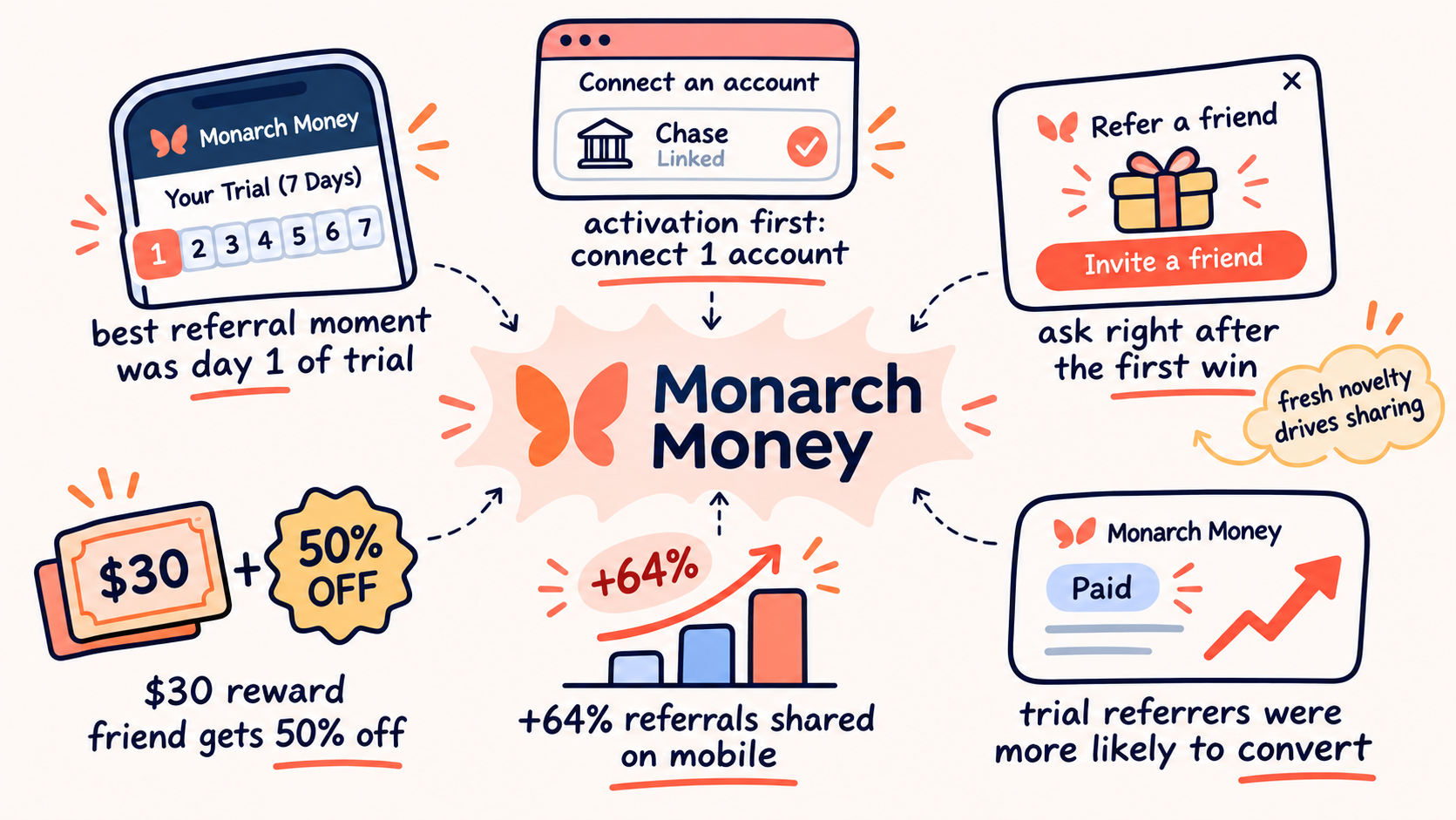
It costs $99.99 a year or $14.99 a month, with a one-week free trial. Like many subscription products, Monarch pays referrers when a friend they invite becomes a paying subscriber. Currently, you receive a $30 reward, and your referred friend receives 50% off their first year.

Sue Cho runs lifecycle marketing (sending customers tailored messages at every step of their journey) at Monarch. When her team was rebuilding its referral program, they made what felt like a pretty reasonable assumption: target paid subscribers that have been using the product long enough to want to refer a friend.
Makes sense. I’m more likely to refer you to a pair of Bombas slipper socks since I’ve worn them all winter and my feet have stayed nice and toasty.
So Monarch never asked trial users to refer anyone. And didn’t mention their referral program. Why ask somebody to recommend the product before they had even decided whether they wanted to pay for it themselves?
Then Sue asked the data team to analyze when users referred the most, and shockingly, it was during the trial. Especially the first day of their trial.
Sue’s reaction: “We were wrong.”
SPONSORED BY

Stride builds teams for early-stage NYC startups and is run by two former PMs who spent the last decade hiring at companies like Amazon, Microsoft, PwC, and VC-backed startups.
If you're struggling to hire or looking for your next role, reach out to their founders: Zakir Tyebjee and Wes Repass.
The Tiny Big Move
The single decision that changed user behavior.
Monarch knew they had to test referral prompting during the free trial. But they didn’t hit users with a referral prompt the moment they signed up. Their data analysis showed users were more likely to refer if they had at least one financial account connected.

If you’ve ever tried a personal finance app, you know the first thing they ask is to connect your bank and credit card accounts. Without that data, the app is useless. This is the activation step for Monarch. It is the step that the user must first take to get value out of Monarch. For Netflix, it’s watching your first show (probably). For Taco Bell, it’s taking the first bite of a delicious Cheesy Gordita Crunch (definitely).

I know half of you are opening up the Taco Bell app right now
Once someone connected an account and saw their finances in Monarch, they’d get an in-app message to refer a friend.

Sue was skeptical and estimated the change might produce about a 20% increase in referral sharing on mobile. Which is still incredible btw and would make for a great answer to the interview question “Tell me about a time you succeeded.”
Instead, Monarch reported incredible results.

And on top of that, users who send a referral during trial have a higher likelihood of converting from trial to paid.
Most Monarch trials begin on the web, so the team expanded the experiment there too. The lift was smaller, but still positive: a 16% increase in referrals shared.
I audibly gasped when I saw the results. It runs counter to everything I know about referral programs. Why would someone want to recommend a product they literally just started using?
The Psychology
There are a few forces overlapping here. First, a fresh win gives people something worth talking about. A review of word-of-mouth research notes that people tend to share things that make them look good, especially experiences that are positive, interesting, surprising, or novel. The better something makes people look, the more likely they are to share it. It’s why LinkedIn is just a series of brag posts, and Instagram is just people having an absolute blast.
After connecting a financial account to Monarch, the user has a new experience of their own to talk about: “I found this thing that pulls all my finances together. I’m so smart because I manage my money better.” Recommending it also lets them be the person who discovered the useful thing first.
But that buzz doesn’t last forever. This is due to the psychological mechanism of hedonic adaptation, where people become accustomed to a positive or negative event. It’s why a new relationship has a “honeymoon period” and “time heals all wounds.”

The excitement of your new fancy budgeting app will fade away, but in that initial moment, you’re excited enough to talk about it. The window is temporary. And it explains why more referrals happened earlier in the customer journey.
Sue was asked whether this tactic would work for a product with a much longer onboarding period; she guessed earlier would still be better because: “The price is just top of their mind when they’re starting their trial.” I actually disagree here. I don’t think price plays that big of a role in the decision to refer.
Instead, there is a more general word-of-mouth effect: people disproportionately talk about things that are happening right now, and recent or environmentally triggered topics are easier to bring to mind. I’m more likely to talk about a fitness app I just started using than a note-taking app I’ve been using forever because it’s top of mind for me. And because I need you to know that I work out.
SPONSORED BY

You bought something online with a credit card. You may have even used the “right” credit card.
But did you:
Activate offers on your credit cards
Use a shopping portal
Check for heavily discounted gift cards
Shoppers who use Savewise earn 7-10x more points & miles for things they’re already buying.
Savewise finds every way for you to earn rewards and puts them all in one place.
The Takeaway
Monarch’s lesson isn’t simply to ask for referrals earlier. It’s to catch users in the short window when they’ve just experienced something worth talking about.
People like sharing things that are new, positive, interesting, and make them look good. That creates an interesting tension.

That gives us a useful rule:
Novelty without value is too early. Value after novelty has faded may be too late.
For Monarch, connecting the first financial account was the trigger. Before that, the user had nothing interesting to say.
And this is broader than referrals. If your product creates a fresh win, that may be the moment to encourage users to tell someone else about it.
Ask for the review while the successful experience is still fresh enough that they want to talk about it. Encourage sharing immediately after someone creates something impressive, hits a milestone, or gets a result worth showing off.
A fitness app might encourage sharing immediately after a personal record. An AI app might ask for a review as soon as it’s generated one result. A language app might ask users to invite a friend right after completing their first lesson.
The important part is that activation comes first. You can’t manufacture enthusiasm by asking someone to share before they’ve experienced anything. But once they have? Don’t necessarily wait until they’ve been a loyal customer for six months.
Catch the win while it still feels like a win in the right win-dow 😂.
This article made me question everything I know. I had trouble believing people would refer on day one of a trial until I dug into the psychology and reasoned through it. Anecdotally, I love talking about new things I’ve started using, but I rarely bring up a product that I’ve had for many years unless prompted. It all tracks. Consider me a convert.
I’m out of office next week, so you won’t hear from me. But it’s okay. I hear that absence makes the heart grow fonder.
— Amaraj (aka I have a referral code for that)
The Meme
