I spend a lot of time watching YouTube videos. It’s usually sports highlights, John Oliver’s absurd commentary, or something about planes. I wish I could say it’s a productive use of time, but I can at least say that it’s incredibly entertaining.
Except for the ads. There are soooooooo many ads. I understand that they need to serve ads to make money, but sometimes I end up watching two whole minutes of ads, just to watch a five-minute clip. The second the skip button appears, I’m clicking it.
Every so often, I’m tempted to get YouTube Premium, just to get rid of the ads. Imagine trying to watch a YouTube how-to video to install a wall A/C unit on a 95-degree day for the first time and NOT getting interrupted with a fifth Old Spice ad (which I proudly haven’t used since high school) while you sweat through your clothes. That’s the dream. But it feels kind of expensive at $15.99/month (more than one Chipotle bowl) to justify the purchase, so instead, you just suffer.
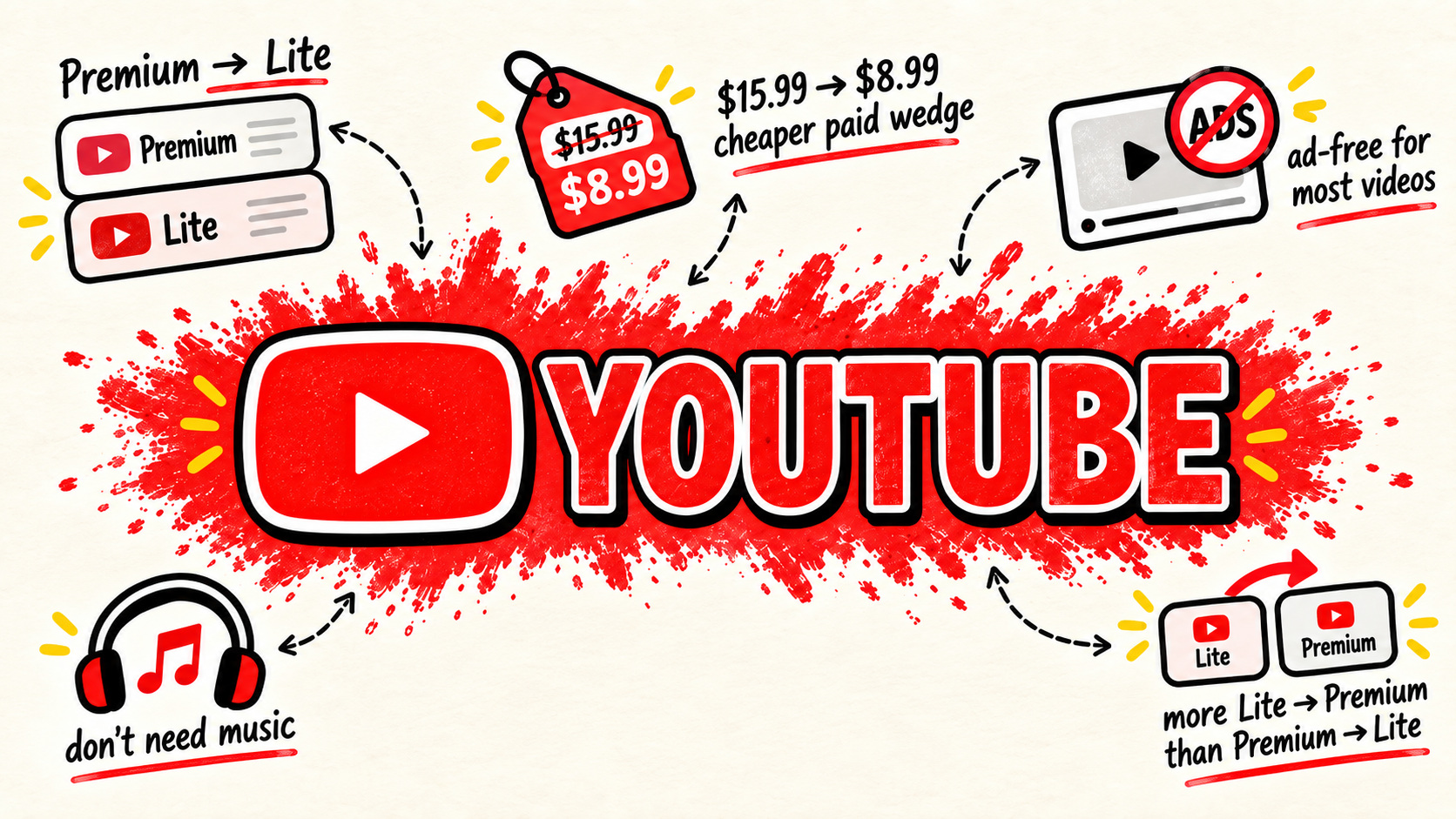
However, I recently discovered that they introduced a new cheaper tier called Premium Lite at a much more affordable $8.99/month (less than one Chipotle bowl), which I might just have to get. This week, I’m digging into YouTube’s decision to introduce a new lower-priced membership and why it’s an incredible move.
The Backstory
How YouTube got here.
YouTube Premium combines a few key features:
Ad-free YouTube
Background play
Downloads
YouTube Music Premium
They don’t necessarily serve the same need. In fact, two distinct user types emerged:
people who use YouTube for everything
people who use YouTube for podcasts and cooking tutorials but stick with Spotify/Apple Music for music. ← this is me
Reuters reported that YouTube had been seeing demand for years among users who already subscribed to competing music services. YouTube product director Jack Greenberg later said YouTube hadn't properly matched a tier to people who “don't need the music content.”

I’m being vulnerable right now and showing you my recommended videos. Notice: no music videos.
YouTube’s problem was that they had two distinct value propositions masquerading as one. It’s like when you had to pay for all the TV channels when all you wanted was Discovery and ESPN. You love one part of the bundle and assign almost no incremental value to another part.
In 2023, YouTube raised U.S. Premium Individual from $11.99 to $13.99. As the bundle got more expensive, it was harder to justify paying for it, especially if you only used one aspect of it. YouTube realized this as well - enter Premium Lite.
SPONSORED BY

Stride builds teams for early-stage NYC startups and is run by two former PMs who spent the last decade hiring at companies like Amazon, Microsoft, PwC, and VC-backed startups.
If you're struggling to hire or looking for your next role, reach out to their founders: Zakir Tyebjee and Wes Repass.
The Tiny Big Move
The single decision that changed how users behaved.
YouTube has been toying around with the idea of Premium Lite for a while. It was tested in a variety of international markets starting in 2021, but was later discontinued. That version omitted background play, downloads, and YouTube Music.
My guess is that YouTube was testing the features that needed to be part of the new offering to succeed. Too many features and everyone from Premium will jump down to the cheaper tier. Too few features and no one will buy it.
In March 2025, Premium Lite was announced in the U.S. for only $7.99/month compared to the $13.99 price point for Premium (both have since risen to $8.99 and $15.99, respectively). It removed ads for most videos, except for music content and Shorts. At launch, it also lacked YouTube Music Premium, background play, and downloads. So it was a much narrower product, focused on one specific Job-to-be-Done.

And that tightly defined scope brought in a new type of paying customer. Reuters reported that YouTube's preliminary pilots produced a new base of first-time subscribers paying for Premium Lite. Meaning these are users who would otherwise not have paid for YouTube!
And as an astute reader, I’m sure you’re wondering if introducing a cheaper tier led to lost revenue from Premium to Lite downgrades. It would make sense that people who were paying for Premium but not using most of the features would opt for Lite. However, YouTube stated that in their pilots, more Lite members upgraded to Premium than Premium members downgraded to Lite. More on this later.
Even with their testing, YouTube didn’t get it right from the jump. Omitting YouTube Music made sense, but features like background play and downloads were valuable to all users. So, in February 2026, YouTube announced both features were coming to Lite for most videos, explicitly saying it had “heard feedback about wanting these additional features included.”
YouTube made Lite more complete at its core job while making it distinct from their Premium offering.
We don’t have exact numbers on the success of Premium Lite (yet), but in Q4 2025, Alphabet told investors Premium Lite was “proving to be a popular choice.” By Q1 2026, it was fully launched in 23 countries, with Alphabet planning more than a dozen additional launches in Q2. And in that same quarter, YouTube Music and Premium had their largest quarterly increase in non-trial subscribers since Premium launched in 2018.
The Psychology
YouTube had a bundling problem that they solved using versioning/mixed bundling, where consumers can self-select into the right bundle for themselves. Research shows that when market segments systematically value components differently, offering multiple bundles can outperform one universal bundle. Aka don't force every customer to buy every job your product can do.
The catch is that each offering, even the cheap tier, needs to feel whole. YouTube Music is an adjacent job for someone listening to an NFL podcast. Background play isn’t if locking your phone immediately stops that podcast. This explains why YouTube eventually added background play and downloads to Lite while keeping music behind Premium.
Returning to the fact that more users upgraded from Lite to Premium than downgraded. There might be some psychology at play behind this. Behavioral economists call it reference dependence: we judge an experience relative to what we’ve gotten used to.
After weeks of ad-free podcasts, highlights, and cooking tutorials, you get used to your uninterrupted videos. Then you put on your favorite Taylor Swift music video and BAM, hit with an ad for Rogaine. You’ve gotten accustomed to luxury, and now the ad feels much worse since your baseline has improved.
SPONSORED BY

You bought something online with a credit card. You may have even used the “right” credit card.
But did you:
Activate offers on your credit cards
Use a shopping portal
Check for heavily discounted gift cards
Shoppers who use Savewise earn 7-10x more points & miles for things they’re already buying.
Savewise finds every way for you to earn rewards and puts them all in one place.
The Takeaway
The lesson here isn’t just to create a cheaper price membership tier. It’s creating a tier for a specific persona to solve their one pain point.
They built a paid wedge. Get users onto the cheaper product that solves their core pain point and then convert a percentage of them to higher tiers.
There was a group of viewers who watched YouTube constantly and hated the ads, but weren't willing to pay $15.99 for a bundle that included things like YouTube Music they didn't value.
Lite isolated the pain they would pay to solve.
Here are patterns to look for in your own product:
A meaningful group of non-customers has one acute problem your larger product already solves.
They don’t value the rest of the bundle enough to justify the full price.
You can solve that one job completely, rather than giving them a crippled version of everything.
A few examples of what this could look like:
Equinox could sell a cheaper membership only to their eucalyptus steam room (which I’ve heard so much about) for people who love to sweat, but hate to work out.
Netflix could offer a membership with only kids’ shows for parents trying to entertain their children.
ChatGPT could create a cheaper membership for people who just want to chat with more intelligent models.
The hardest part here is determining who those non-customers are, which is usually done through user research. Once you understand why these users are interested in your product, but unwilling to pay for it, you can create the paid wedge for them.
A good paid wedge can therefore do three jobs:
Convert the non-customer.
Deliver enough value to become useful on its own.
Create a natural path into the rest of the product.
Every time I cover a product, I find a new appreciation for it. This time, it’s going to cost me $8.99/month. If you’re wondering how to apply this lesson or any of the previous lessons to your business, reach out to me; we can talk through it.
Before I sign off, many readers have asked me to bring back the riddles from my previous newsletter. I can’t promise there will always be a riddle, but here’s one:
Riddle of the week: I can be opened but never closed. What am I?
Reply with your answers to see if you win!
— Amaraj (aka Amaraj Lite when I’m feeling tired)
The Meme

Me as the PM of YouTube Ads
Sharing is Caring
If you liked the article today, consider sharing it or this rad infographic below with your friends and coworkers.
